
How to Search Neshoba County Court Records
The main online system for Neshoba County Circuit and Chancery files is Mississippi Electronic Courts, known as MEC. The public side of that system is called Public Access to Mississippi Electronic Courts, or PAMEC. The state judiciary uses MEC for trial court electronic filing. Neshoba does not run one single portal for every court. Circuit cases sit in the Eighth Circuit Court District. Chancery cases sit in the Sixth Chancery Court District. Each district has its own MEC court information page and its own go-live date.
Before starting, gather a few details. A full name helps. A case number helps even more. You should also know the kind of case, since the right court depends on the matter. Live document viewing through PAMEC can require an account and per-page fees, so the clerk counter remains a strong backup.
The state judiciary explains its MEC electronic access system in plain terms on its own site. The screen below shows that landing page for filers and public users.
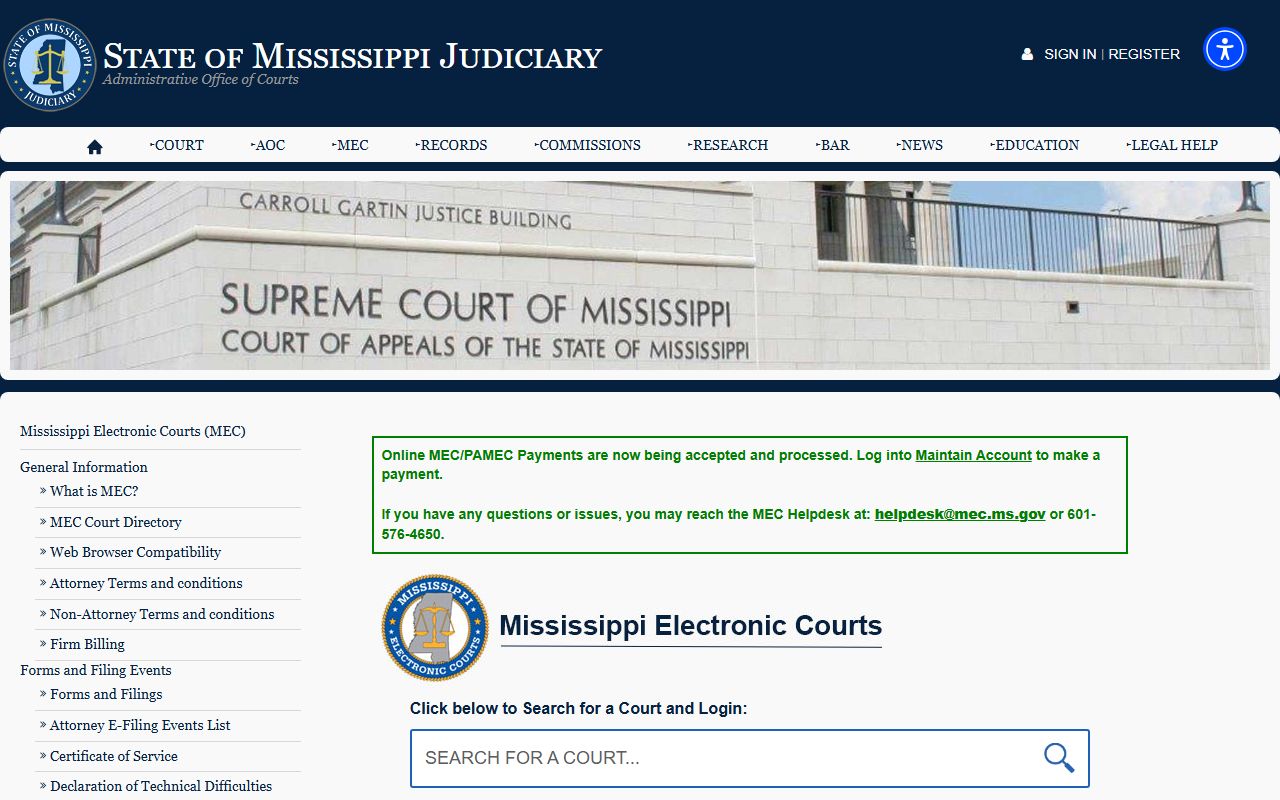
That page is the gateway to both the Circuit and Chancery district systems that hold Neshoba County court records. The steps below walk through a basic search.
- Identify the court level first. Felony and major civil cases route to Circuit Court. Divorce, custody, probate, land, and guardianship route to Chancery Court. Small claims, county misdemeanors, and county traffic route to Justice Court. City cases route to a municipal court.
- For a Circuit or Chancery case, open MEC or PAMEC and pick the matching district. Use the Eighth Circuit Court District for Circuit cases and the Sixth Chancery Court District for Chancery, probate, and divorce matters.
- Enter a party name or case number, then narrow by case type and filing date if those options appear.
- Review the docket entries, status flags, and hearing settings shown for the case.
- If documents are locked behind a login or fee, call or visit the clerk. The Circuit Clerk line is 601-656-4781. The Chancery Clerk line is 601-656-3581.
Note: In-person inspection at the courthouse avoids online document-viewing fees, though copy charges may still apply at the counter.
The Neshoba County Court System
Mississippi splits trial work among several courts. The Neshoba County Circuit Court hears felony prosecutions, larger civil suits, jury trials, and appeals from lower courts. The Chancery Court handles equity, divorce, custody, adoption, land title, estates, guardianship, conservatorship, and mental-health commitment cases. Justice Court covers small civil claims, county misdemeanors, traffic, and early criminal steps. Municipal courts in Philadelphia and Union handle cases that happen inside city limits. Youth Court handles juvenile matters, and those records are closed to the public.
Neshoba County's Circuit Court belongs to the Eighth Circuit Court District. State law sets that district as Leake, Neshoba, Newton, and Scott counties, with two judge seats called Place One and Place Two. Judge Caleb May holds Place One. Judge Christopher Posey holds Place Two. The Chancery Court sits in the Sixth Chancery Court District, served by Judge Doug S. Crosby, Judge James C. Walker, and Judge Joseph Kilgore. Justice Court has two local judges as well.
The Mississippi Judiciary describes each of these court roles on its about the courts page. The image below shows that official overview.
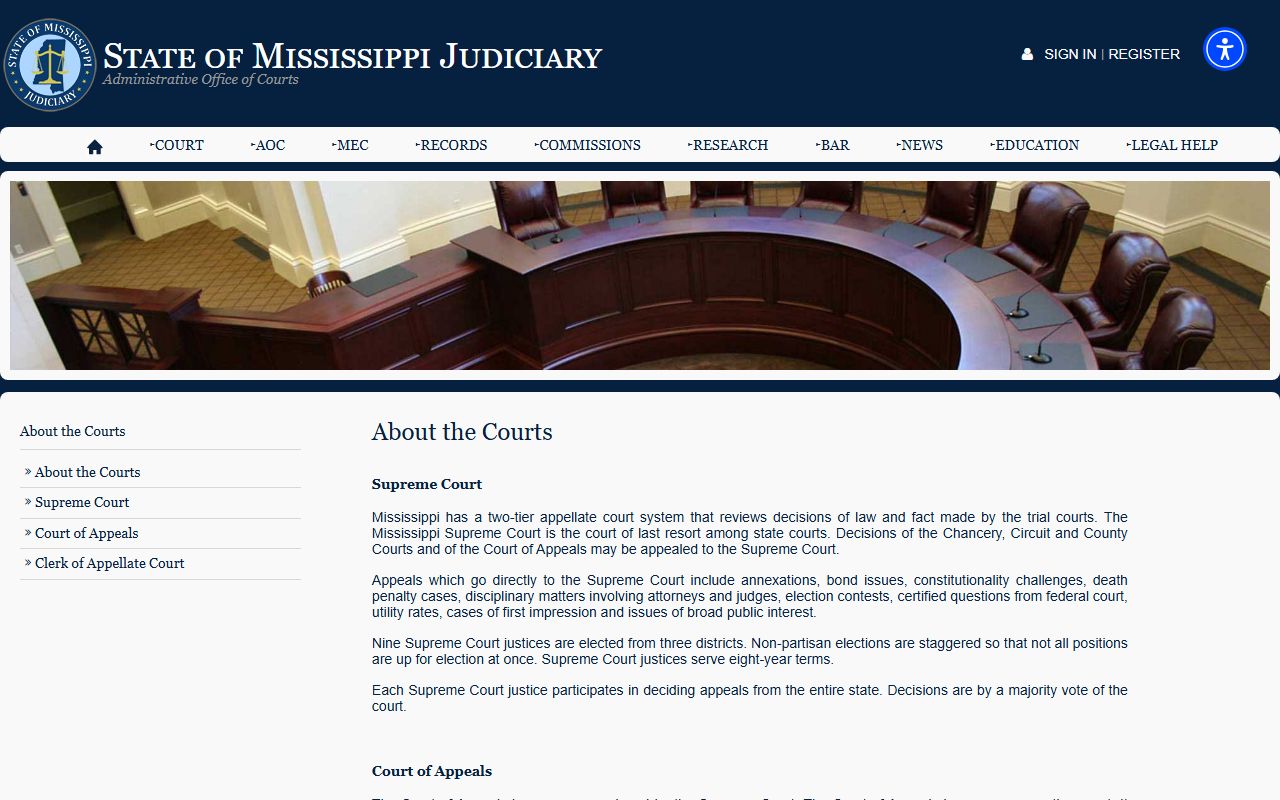
That state guide pairs well with the local court table here, which lists the main Neshoba offices and what each one handles.
Case flow: Justice/Municipal Court › Circuit Court › Mississippi Court of Appeals › Mississippi Supreme Court
| Court | Jurisdiction | Case Types |
|---|---|---|
| Circuit Court (Eighth District) | General trial court | Felonies, major civil suits, jury trials, lower-court appeals |
| Chancery Court (Sixth District) | Equity and family | Divorce, custody, probate, land title, guardianship, commitments |
| Justice Court | Limited jurisdiction | Small civil claims, county misdemeanors, traffic, preliminary criminal |
| Municipal Court | City limits | Ordinance, parking, city traffic, misdemeanors |
| Youth Court | Juvenile | Confidential juvenile and child matters |
Neshoba County Courthouse and Clerk Offices
The main building for court-record work is the Neshoba County Courthouse at 401 East Beacon Street in Philadelphia. The Circuit Clerk sits in Suite 110. The Chancery Clerk sits in Suite 107. The Board of Supervisors and judge's chambers also cluster inside this courthouse. Clerk duties are split. The Circuit Clerk, Delana A. Waddell, handles Circuit Court filings and marriage license applications. The Chancery Clerk, Gidget Stovall Tate, handles Chancery filings, land records, probate files, and divorce decree copies.
Not every office sits in the courthouse. Justice Court runs from an annex at 200 Byrd Avenue. The Law Enforcement Center and jail sit at 920 Chestnut Street. Youth Court is listed at 305 Main Street. A person going for a felony case file should not drive to the jail for copies, and a person paying a Justice Court traffic fine should use the Byrd Avenue annex, not the Chancery Clerk.
The official Neshoba County website serves as the front door to these offices and their contact pages. The screenshot below shows that county homepage.
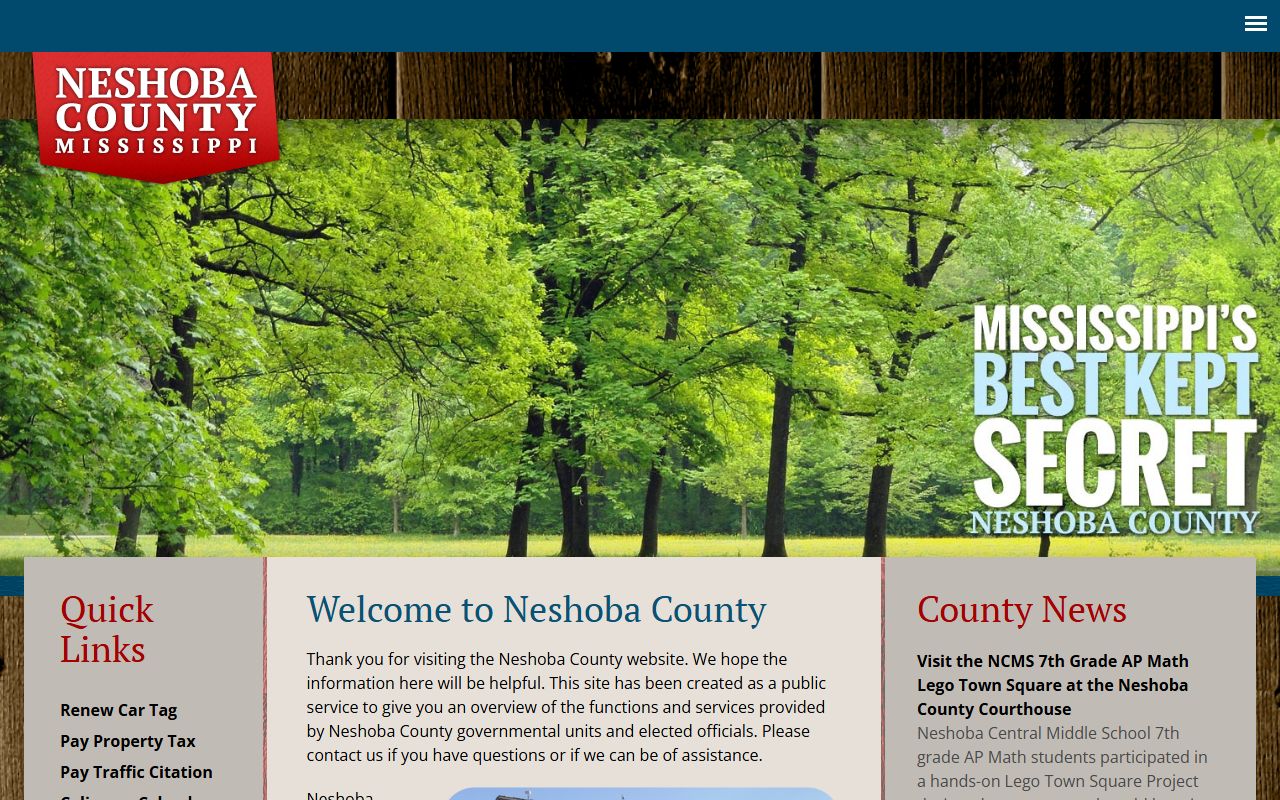
From that homepage, visitors reach the clerk pages, court pages, and the contact directory. The cards below list the core counter locations.
Neshoba County Circuit Clerk
401 East Beacon Street, Suite 110
Philadelphia, MS 39350
601-656-4781
Neshoba County Chancery Clerk
401 E. Beacon Street, Suite 107
Philadelphia, MS 39350
601-656-3581
Types of Court Records Available in Neshoba County
Neshoba County court records cover a wide span of case work. The court that produces a record depends on the matter. Felony and big civil files come from Circuit Court. Family, estate, and land files come from Chancery Court. Traffic and small cases come from Justice and municipal courts. Some records, such as youth files, never open to the public.
Most readers look for one of a handful of record types. The list below sorts the common ones by where they live.
- Criminal records - felony files in Circuit Court hold the indictment, pleas, verdict, and sentence; misdemeanors sit in Justice or municipal court.
- Civil records - lawsuits, judgments, garnishments, and cost bills are filed in Circuit Court when not assigned elsewhere.
- Family and divorce records - divorce, custody, alimony, and adoption matters run through Chancery Court, with adoption files kept confidential.
- Probate records - wills, estates, guardianships, and conservatorships are Chancery matters held by the Chancery Clerk.
- Traffic records - county citations route to Justice Court, while city tickets route to a municipal court.
Mental-health commitment files and protective orders also arise across these courts, though access can be limited when minors or safety issues are involved.
What Neshoba County Court Records Show
A court file follows a steady pattern across case types. Most records open with a case number and the court that holds the case. Then come the parties, the filing date, and the docket of every event since. Criminal files add charges, pleas, and a final disposition. Civil and Chancery files add motions, orders, and decrees. Financial fields track fines, fees, bond, and restitution.
The MEC system also attaches status flags to a case. The general-information page for the state system explains how those electronic dockets and documents appear. The flags help readers understand a case even when the documents stay sealed.
The Mississippi Judiciary outlines this on its MEC general information page. The screenshot below shows that explanation.
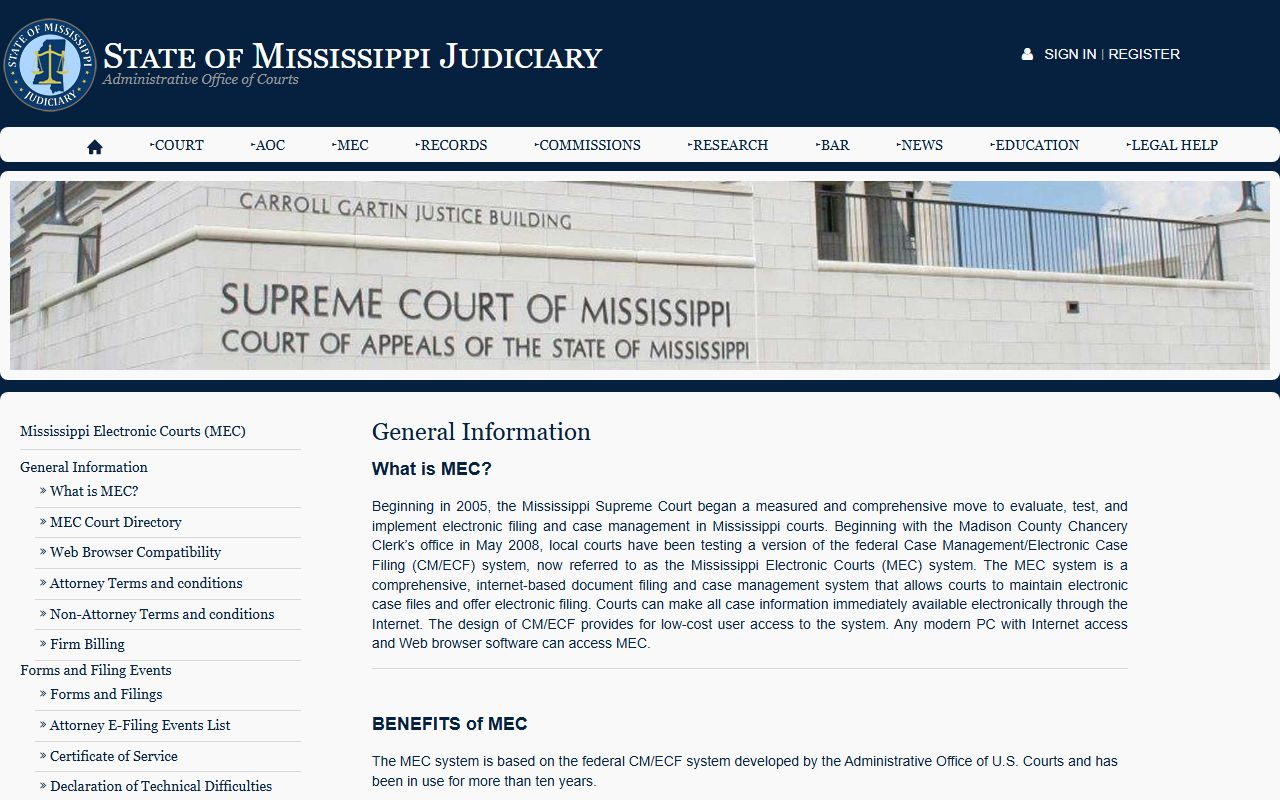
The table below maps the most common fields a reader will see in a Neshoba County court record.
| Field | What It Shows |
|---|---|
| Case Number | The unique ID assigned by the filing court or the MEC system. |
| Filing Date | The day the complaint, petition, indictment, or citation opened the case. |
| Parties | Plaintiff and defendant, the state and defendant, or petitioner and respondent. |
| Charges / Cause | The offense charged in a criminal file or the claim raised in a civil file. |
| Disposition | The final outcome, such as a plea, verdict, dismissal, or decree. |
| Sentence / Judgment | The penalty, money owed, or relief the court ordered. |
Reading Neshoba County Court Docket Terms
Dockets use shorthand that can confuse first-time readers. The Eighth Circuit MEC system uses flags such as Case Closed, Trial Pending, Plea Pending, Bench Warrant Issued, Capias Pending, Expunged, and Sealed Case. The Sixth Chancery system adds probate flags such as Adult Ward, Minor Ward, Guardian Plan, Conservator Plan, and Notice of Accounting Due. These flags signal the stage of a case at a glance.
A short glossary clears up the words that appear most often in a Neshoba County court record. Each term below shows up on real dockets across the local courts.
- Disposition
- The final result of a charge or case.
- Capias
- A court order to arrest, often issued after a failure to appear.
- Bound over
- A lower-court matter sent up to Circuit Court for felony prosecution.
- Nolle prosequi
- The prosecutor's decision not to move forward on a charge.
- Decree
- A final Chancery Court order, common in divorce and probate cases.
- Expunction
- The legal removal of an eligible record from public access.
A charge is not the same as a conviction. A charge only states what the prosecutor alleges. A conviction means the court found guilt through a plea or a verdict, so a docket that lists a charge with no disposition has not reached an outcome.
Public Access Laws for Neshoba County Court Records
Mississippi law treats most court and government records as open. The Public Records Act gives any person the right to inspect public records unless an exception applies. Statutes carve out narrow exceptions for juvenile files, mental-health records, and sealed or expunged cases. The county's own policy follows the same spirit and adds practical steps for copies.
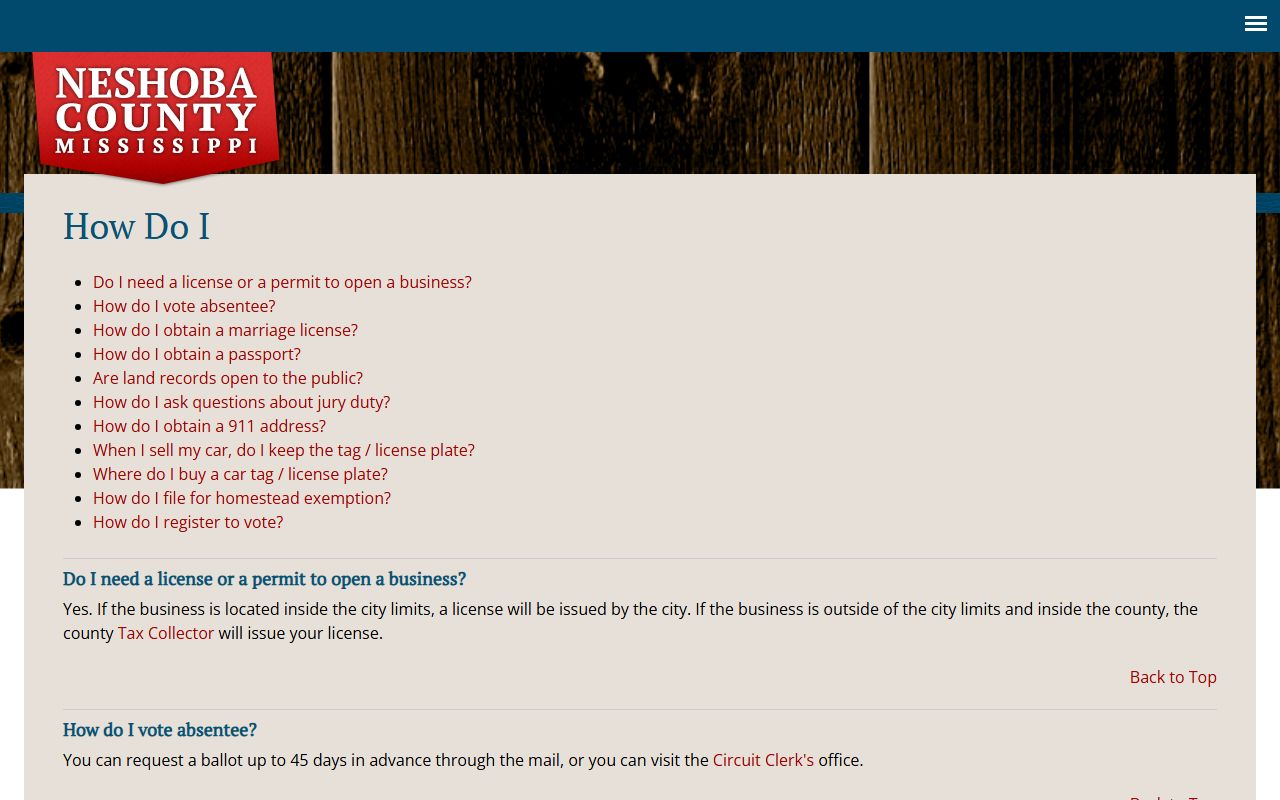
The county FAQ confirms that land records stay open for public inspection at the Chancery Clerk's office during business hours. That page also covers passport and marriage details handled at the Circuit Clerk. The screenshot below shows that county how-do-I guide.
The county how-do-I page answers several common record questions for residents.
The statutes below set the legal frame for access and confidentiality across Neshoba County court records.
Key Statutes:
Miss. Code § 25-61-1 - States the public policy that government records stay open for inspection.
Miss. Code § 25-61-5 - Sets the right to inspect and lets offices adopt reasonable written request rules.
Miss. Code § 99-19-71 - Governs expunction of eligible dismissals, acquittals, dropped charges, and some convictions.
Miss. Code § 43-21-259 - Keeps youth-court records confidential absent statutory authority or a court order.
Miss. Code § 41-21-97 - Protects mental-health treatment records and related patient information.
Note: State law supports open access but never overrides a sealed, expunged, juvenile, adoption, or mental-health restriction on a file.
Records That Are Restricted or Confidential
Some Neshoba County court records stay closed by law. Youth Court files are confidential and not ordinary public records. Sealed cases may show little or no detail in the system. Expunged records drop out of public access once a judge signs the order and each office carries it out. Adoption files run through Chancery Court but remain confidential. Mental-health commitment and treatment records are protected as well.
Personal identifiers are guarded across all file types. Social Security numbers, financial account numbers, birth dates, and minor identities should be redacted or withheld. To clear an eligible record, a person normally files an expunction petition in the court that holds it, pays any fee, and serves the required parties. The change is not instant. A record only leaves public systems after the order is entered and each custodian acts on it.
Comparing Neshoba County Court Types
Picking the right court saves time. The split between Circuit and Chancery confuses many residents because both are trial courts that meet in the same building. The difference is the kind of case each one hears. Justice Court and the municipal courts sit below them for smaller matters.
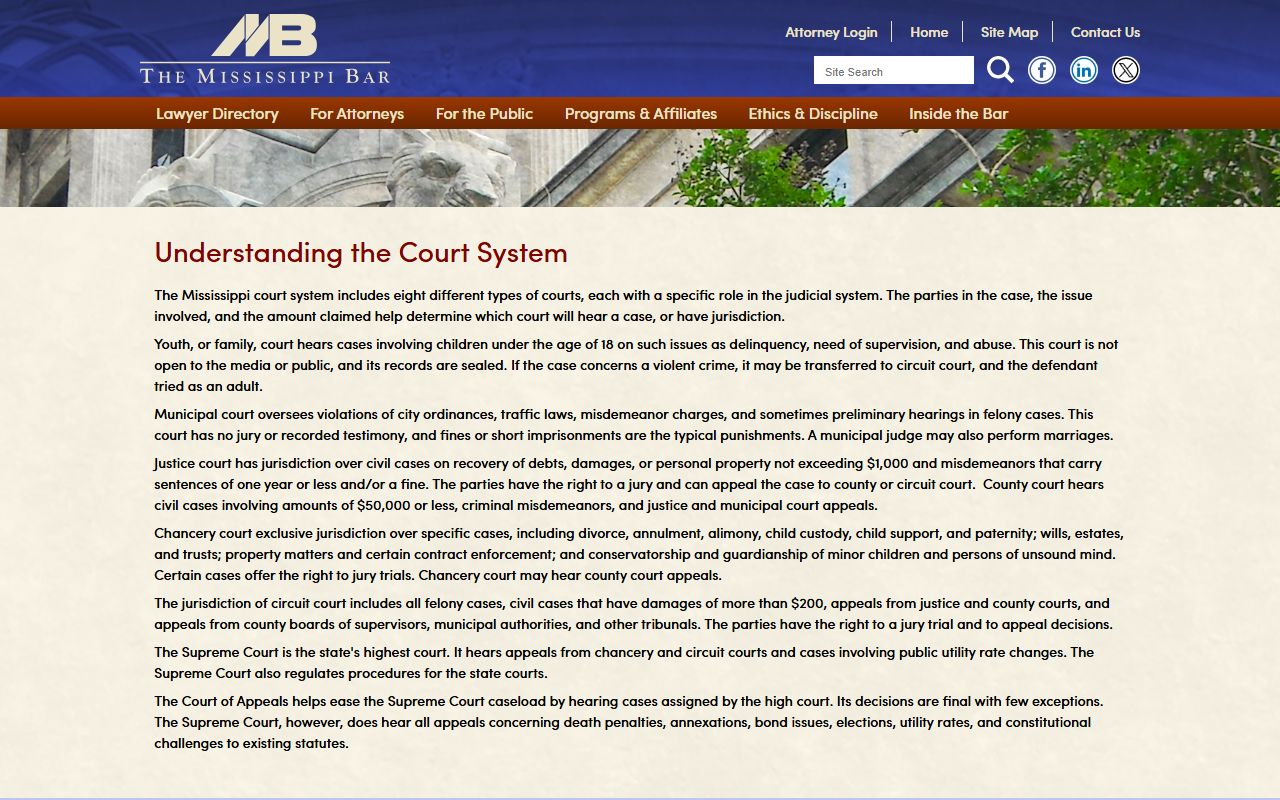
The Mississippi Bar offers a plain-language guide to the state court system for the public. The image below shows that consumer explanation.
The Mississippi Bar court-system guide breaks down jurisdiction for non-lawyers.
The table below compares the three court tiers a typical reader will deal with in Neshoba County.
| Feature | Circuit Court | Chancery Court | Justice Court |
|---|---|---|---|
| Main role | Felony and major civil | Equity and family | Small and preliminary |
| Common cases | Crimes, lawsuits, appeals | Divorce, probate, land | Misdemeanors, traffic, small claims |
| Clerk | Circuit Clerk | Chancery Clerk | Justice Court Clerk |
| Online system | Eighth Circuit MEC | Sixth Chancery MEC | Office and phone |
Neshoba County Sheriff and Jail
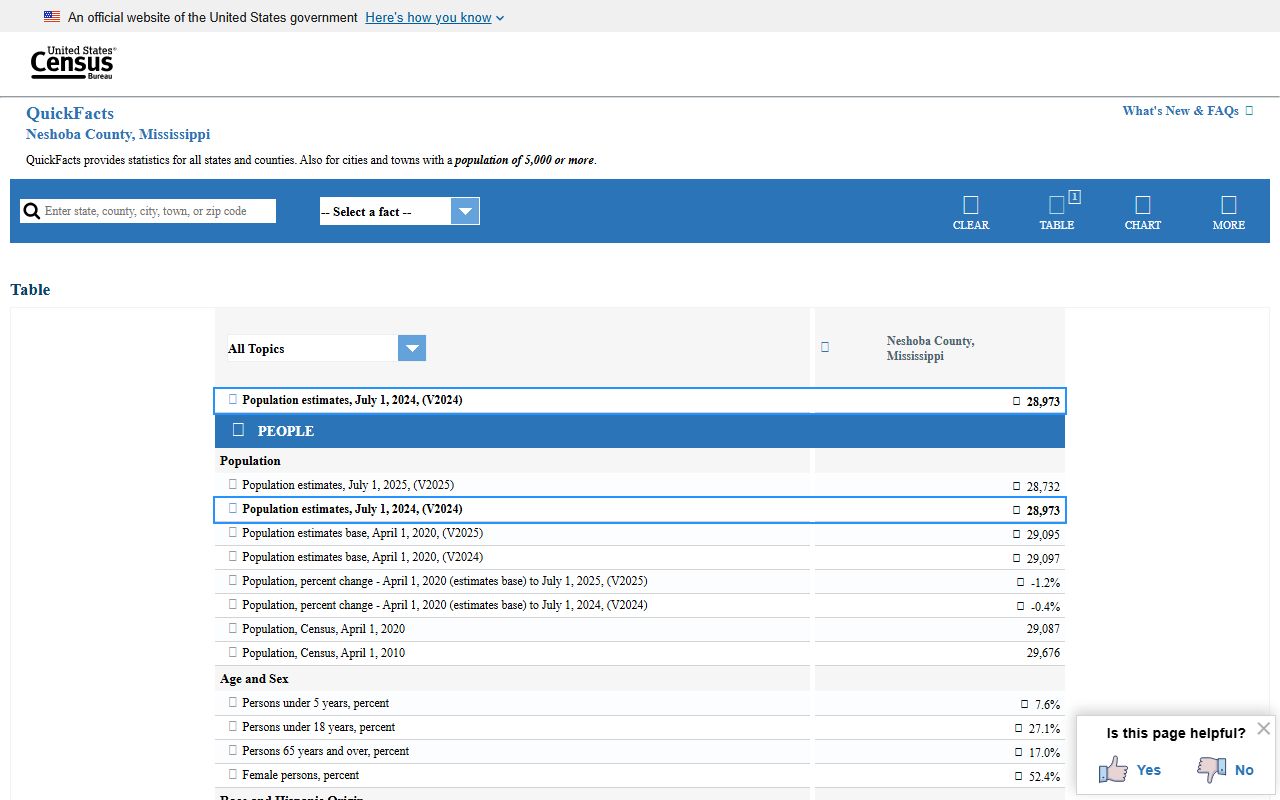
Sheriff Eric Clark leads the Neshoba County Sheriff's Department at 920 Chestnut Street in Philadelphia. The phone line is 601-656-1414. Jail administrator Amanda Wilkerson runs the Law Enforcement Center, which opened in January 1995 with 52 maximum-security beds and 12 work-crew beds. The sheriff also keeps the jail docket, a duty that supports inmate and charge lookups. Neshoba is a rural county of roughly 29,000 people spread across about 570 square miles.
The official county website does not publish a live web jail roster. The county's strongest digital channel is the Neshoba County Sheriff MS app, available on Apple and Google Play. Launch reporting describes an inmate roster, a Most Wanted list, tip submission, jail information, and push alerts. For sentenced state inmates, use the statewide MDOC search instead of the county channel.
Population and area figures for the county come from the U.S. Census QuickFacts page. The screenshot below shows those county statistics.
For the full roster, booking detail, and contact methods, see the Neshoba County inmate records page, and for active warrants see the warrant records page.
Marriage, Divorce, and Probate Records
Marriage licenses route through the Circuit Clerk, who links the county marriage license application. Divorce decrees route through the Chancery Clerk, since divorce is a Chancery matter. The state health department does not hold divorce decrees, but it can run a five-year index search of county records for a small fee to find the county, book, and page. The Chancery Clerk then supplies the certified copy.
Probate is a Chancery Court function as well, not a separate office. The Chancery Clerk keeps wills, estate files, guardianships, and conservatorships. Readers can compare these channels on the marriage and divorce records page and the probate records page. The terms below appear often in probate files.
- Testator
- A person who makes a will.
- Executor
- The person named to carry out a will's terms.
- Conservator
- A person the court appoints to manage an adult ward's affairs.
Neshoba County Court Records Fees
The county public-record policy sets clear copy rules. Any person may inspect records for free during regular working hours. A requester may hand-copy a record at no cost. A copy made on the office machine costs fifty cents per page. When a county employee must search, copy, and mail a record, the policy requires a minimum deposit and gives the office fourteen days to produce the record or explain the delay in writing.
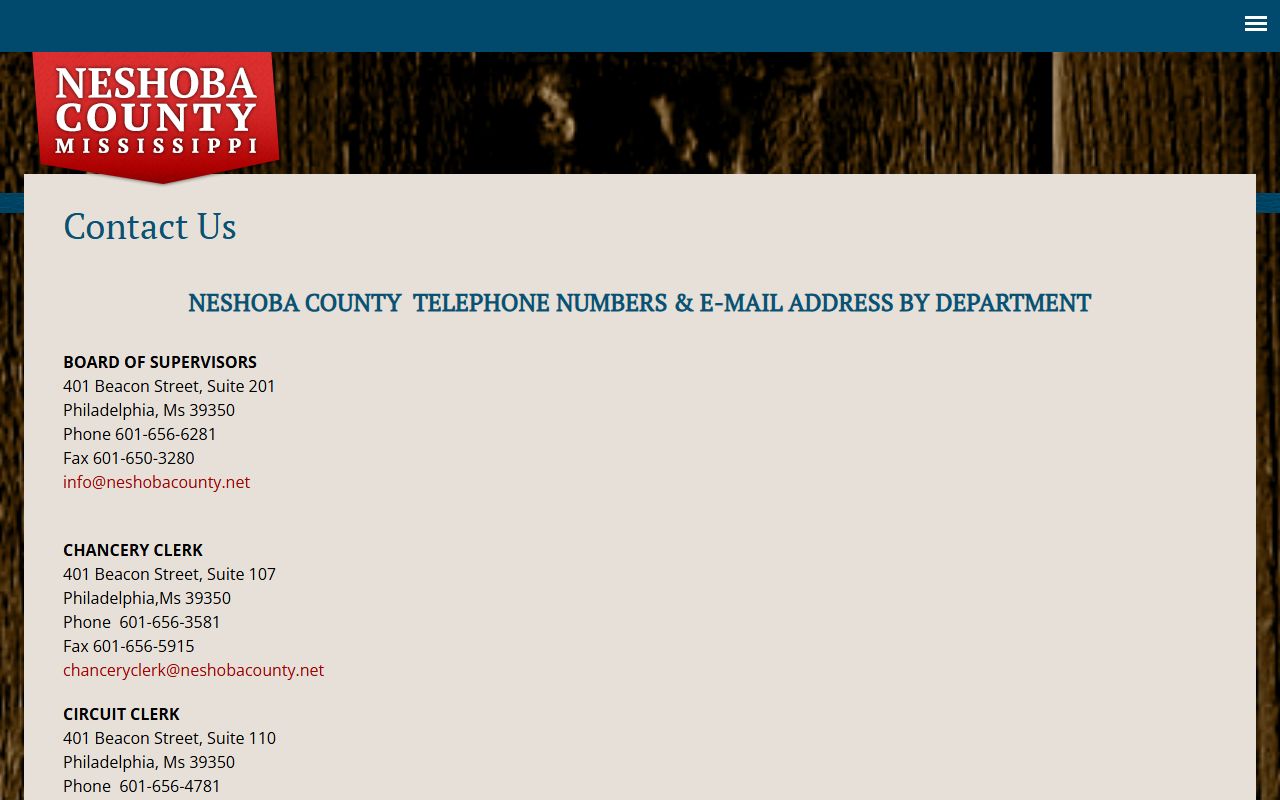
The county contact directory lists the offices that hold these records and their phone lines. The screenshot below shows that directory.
The county contact directory points readers to the right custodian office for a copy request.
The fee table below summarizes the published amounts.
| Item | Amount |
|---|---|
| In-office inspection | No charge during working hours |
| Hand copies by requester | No charge |
| Mechanical copy per page | $0.50 |
| Minimum deposit for employee search, copy, and mail | $30.00 |
| Extensive research | Estimated hourly deposit at time of request |
| Certified copy fee | Not published; contact the clerk |
Note: Certified copy fees and marriage license fees are not posted in official county sources, so call the clerk for the current amount before you visit.
History of the Neshoba County Courthouse
Neshoba County was created by the state legislature on December 23, 1833, and Philadelphia became the county seat in 1837. The present courthouse rose in 1928 to a design by architect Robert C. Springer of Meridian. Side wings were added in 1954. State archives records describe the building as the fourth courthouse in the county's history, so earlier buildings stood before it.
The courthouse also holds a notable place in civil-rights history. Records from the Mississippi Department of Archives and History state that Dr. Martin Luther King Jr. spoke from the north portico steps in 1964 and again in 1966. Those addresses closed marches that called for prosecution in the murders of three civil-rights workers killed in June 1964. The site stands as a marker of public accountability and the courts.
The state archives property record documents the building's design and history. The screenshot below shows those courthouse facts.
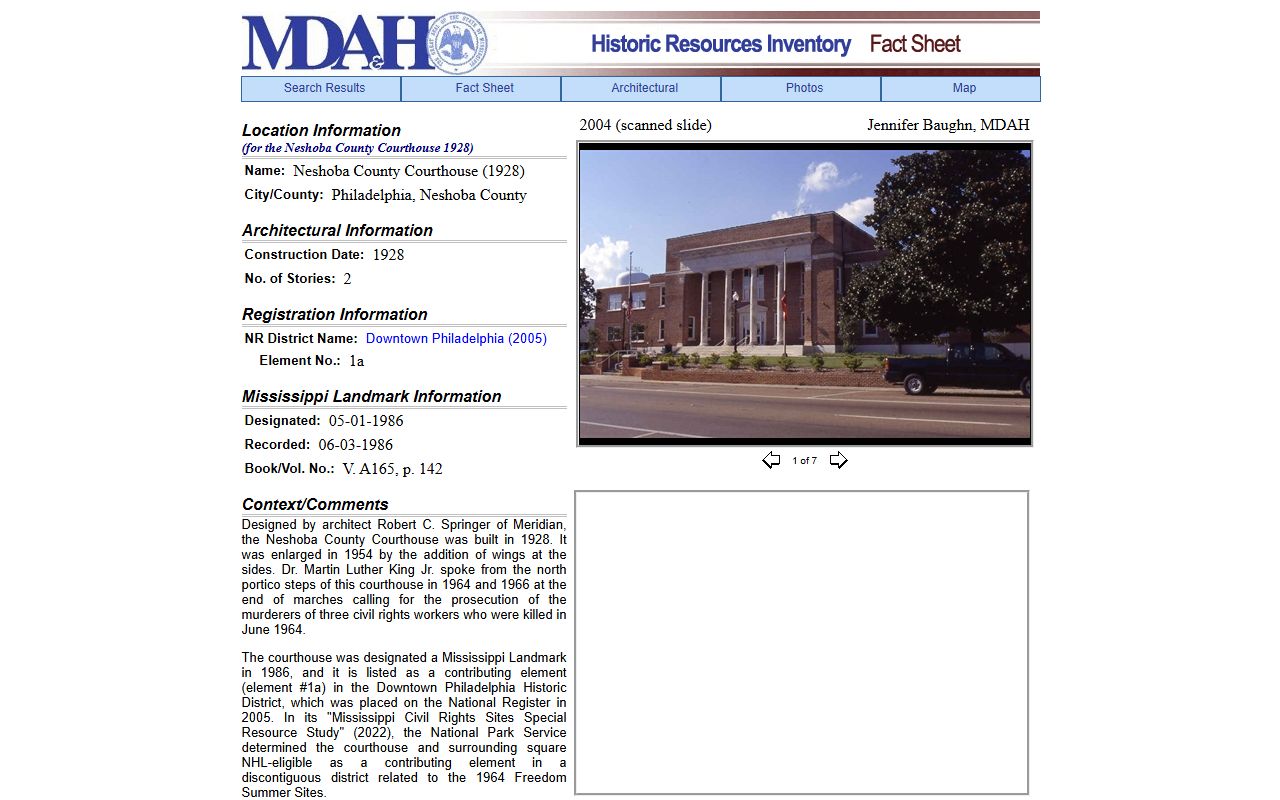
The modern record story is recent. Chancery Court has filed electronically since March 2017, while Circuit Court went live on the electronic system in June 2024, a major step for online access to Neshoba County court records.
Frequently Asked Questions
How do I search Neshoba County court records online?
Start with Mississippi Electronic Courts and pick the right district. Circuit cases use the Eighth Circuit Court District system. Chancery cases use the Sixth Chancery Court District system. Search by party name or case number, then review the docket. If documents are locked behind a login or fee, call the clerk or visit the courthouse to inspect the file in person.
Which court holds my case?
The case type decides the court. Felonies and large civil suits sit in Circuit Court. Divorce, custody, probate, and land matters sit in Chancery Court. Small claims, county misdemeanors, and county traffic sit in Justice Court. Cases that happen inside Philadelphia or Union city limits sit in those municipal courts. Youth matters go to Youth Court, where records stay confidential.
How much does a copy of a court record cost?
Inspection is free during business hours. A copy made on the office machine costs fifty cents per page. When a county employee handles a search, copy, or mailing, the policy sets a thirty-dollar minimum deposit. Certified copy fees are not posted online, so call the Circuit Clerk at 601-656-4781 or the Chancery Clerk at 601-656-3581 for the current rate.
Is there a website to check for warrants or jail inmates?
The county does not publish a web warrant search or a live web jail roster. The Neshoba County Sheriff MS app is the main digital channel, with an inmate roster and a Most Wanted list. You can also call the Law Enforcement Center at 601-656-1414. For sentenced state inmates, use the statewide MDOC search instead of the county tools.
How do I get a marriage license or a divorce decree?
Marriage licenses go through the Circuit Clerk, who provides the county application form. Divorce decrees go through the Chancery Clerk, since divorce is a Chancery case. If you do not know the county of divorce, the state health department can run a five-year index search to find the county, book, and page, and then the Chancery Clerk issues the certified copy.
Why can I not see some Neshoba County court records?
Several record types are closed by law. Youth Court files, sealed cases, and expunged records are not open to the public. Adoption files and mental-health commitment records are confidential too. Even in open files, personal identifiers like Social Security numbers and minor identities are redacted. To clear an eligible record, file an expunction petition in the court that holds it.
How current are the records online?
Online updates can lag behind the counter. Circuit Court only joined the electronic system in June 2024, so older Circuit files may not appear online and may need a clerk request. Chancery Court has filed electronically since 2017. When timing matters, confirm a status with the clerk's office rather than relying on the online docket alone.