
How to Search Neshoba County Traffic Records
Neshoba County does not run a single web page where every traffic ticket can be pulled up by name. The record sits with the court that handled the citation. County tickets are kept by the Justice Court at 200 Byrd Avenue in Philadelphia. City tickets are kept by the municipal court for the town where the stop happened. A driver who needs a fine amount, a court date, or a payment status calls or visits that court. The Justice Court line is 601-656-4053.
Before reaching out, pull the paper citation. It lists the officer, the agency, the charge, and a court or response date. That date points to the court you must contact. Having the citation number ready speeds up any call. A driver license number and a date of birth help the clerk match the file when the ticket is lost.
- Read the citation to find the issuing court and any court date.
- Match the court: Justice Court for county stops, Philadelphia or Union Municipal Court for city stops.
- Call that court with the citation number, the driver name, and a date of birth.
- Ask for the charge, the fine, the court date, the plea options, and the payment status.
- Pay in the office or by phone, or ask how to contest the ticket.
The county's official pay traffic citations and fines page lays out the Justice Court payment options for drivers.
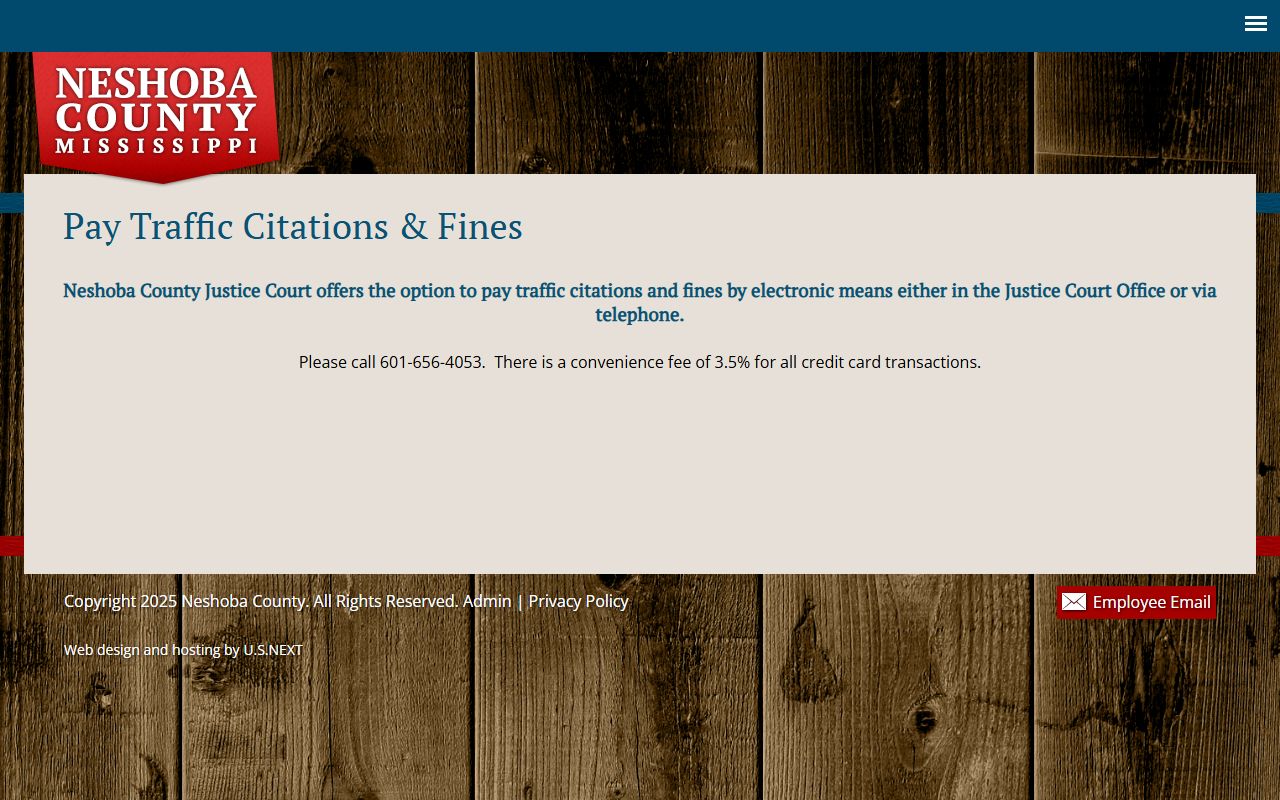
That page confirms a county fine can be paid in the Justice Court office or by phone, with a card convenience fee added at checkout. It gives the office number to call rather than a web search box.
Which Courts Handle Neshoba County Traffic Cases
Venue turns on where the citation was issued. A stop on a county road or state highway outside the cities routes to the Neshoba County Justice Court. A stop inside Philadelphia routes to the Philadelphia Municipal Court. A stop inside Union routes to the Union Municipal Court. Each court keeps its own files, sets its own dockets, and takes its own payments.
The Justice Court handles county traffic citations and fines along with misdemeanors and small civil matters. The Philadelphia Municipal Court hears traffic and parking offenses, city ordinance cases, and lower misdemeanors inside the city limits. The Union Municipal Court does the same job for the town of Union. The table below lists each court with the cases it handles and where to find it.
| Court | Traffic Cases Handled | Address |
|---|---|---|
| Neshoba County Justice Court | County traffic citations and fines, misdemeanors, small claims | 200 Byrd Avenue, Philadelphia, MS 39350 |
| Philadelphia Municipal Court | Traffic, parking, city ordinance, and lower misdemeanor cases inside the city limits | 525 Main Street, Philadelphia, MS 39350 |
| Union Municipal Court | City traffic and ordinance citations inside Union | 404 Bank Street, Union, MS 39365 |
The City of Union Municipal Court page shows how Union takes payment on its own traffic fines.
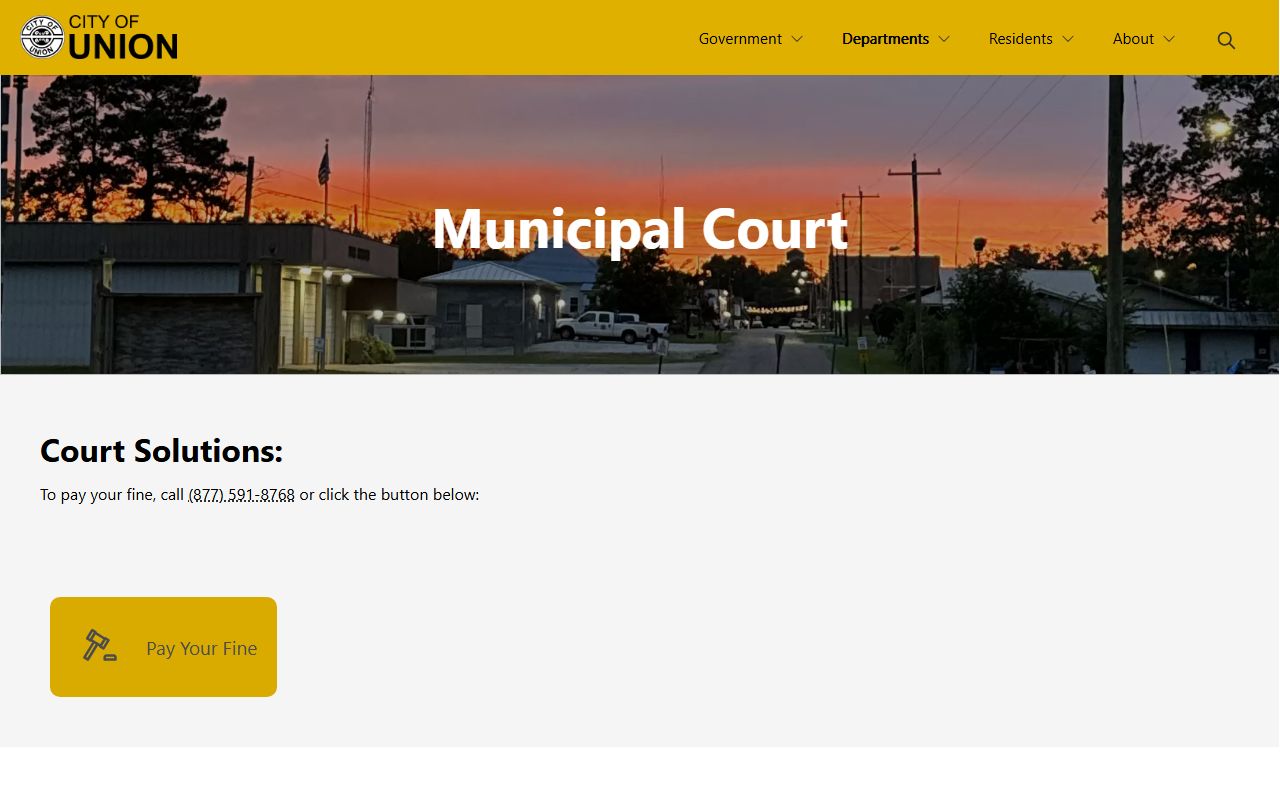
Union routes card payments through a Court Solutions phone line, which is separate from the county Justice Court channel. A driver should always confirm the court named on the ticket before sending money.
Types of Traffic Cases on Record
Traffic files cover a wide span of offenses. Most are minor and end with a fine. Some are serious enough to move toward criminal court. The label on the citation tells you which kind you have. The list below groups the common types seen across the county and city courts.
- Moving violations - speeding, running a stop sign, improper passing, and similar driving offenses.
- Equipment and non-moving - broken lights, expired tags, and registration problems.
- Insurance and license - no proof of insurance, or driving on a suspended or revoked license.
- Commercial vehicle - violations tied to a commercial driver license or a commercial truck.
- Serious traffic charges - DUI, reckless driving, or leaving the scene, which often shift to criminal court.
Parking tickets and city ordinance citations also show up on municipal court dockets. The Philadelphia Municipal Court is the venue for parking offenses written inside that city. A driver unsure of a charge can read the statute or code number printed on the ticket and ask the clerk to explain it.
What Neshoba County Traffic Records Show
A traffic court file tracks a single citation from the day it is written to the day it is paid or closed. It names the driver, the charge, and the court. It also tracks money owed and whether a court date was kept. The fields below are the ones a clerk reads back when you call about a ticket.
| Field | What It Shows |
|---|---|
| Citation Number | The number printed on the ticket, used to pull the case where one is on file. |
| Charge / Violation | The offense cited, such as speeding or no insurance, with its code or statute. |
| Court Date | The hearing date or the deadline to respond to the citation. |
| Plea | How the driver answered the charge, such as guilty, not guilty, or no contest. |
| Fine and Costs | The base fine plus court costs and any added fees. |
| Disposition | The final outcome, such as paid, dismissed, or reduced. |
| Payment Status | Whether the balance is open, partial, or paid in full. |
| Warrant Flag | Any failure-to-appear or bench warrant tied to a missed court date. |
Note: A local citation-number format is not published in official county sources, so confirm the exact number and court with the issuing clerk.
How to Pay or Contest a Neshoba County Traffic Ticket
Paying a ticket and fighting a ticket start the same way. You find the court and you call it. The county Justice Court takes payment in the office or over the phone. The two city courts use their own channels. A driver should never assume a guilty plea is the only choice.
Some citations require a court appearance and cannot be settled by mail or phone. DUI, a commercial license charge, an accident, no insurance, a suspended license, and a missed court date all fall in that group. Call the court first in those cases. The steps below walk through both paying and contesting.
- Identify the court from the citation: Justice Court, Philadelphia Municipal Court, or Union Municipal Court.
- Call before paying if the ticket involves DUI, a CDL, an accident, no insurance, a suspended license, or a missed court date.
- For a county ticket, pay in the Justice Court office or by phone at 601-656-4053, and expect a 3.5 percent card fee.
- For a Philadelphia city ticket, contact the Municipal Court clerk at 601-650-3584.
- For a Union city fine, call Court Solutions at 877-591-8768 or use the city payment button.
- To contest, ask the clerk how to plead not guilty, request a hearing, or reschedule a court date.
- If you missed court, ask whether a bench warrant, a license hold, or an extra fee has been added.
Citation Number vs Name Lookup
No official county page offers a public web form to search a traffic citation by name or number. The lookup happens by phone or in person. A citation number is the fastest match because it points the clerk straight to one case. A name search can return more than one person, so the clerk may also ask for a date of birth or a license number.
The channels below are the ones the county and city courts actually publish. They are payment and contact paths, not open search boxes. Card payments carry a convenience fee, and each court runs its own system.
| Search / Pay Channel | Type | Required | Notes / Format |
|---|---|---|---|
| Justice Court phone payment | Phone | n/a | Call 601-656-4053; exact web fields are not published. |
| Payment method | Card / payment | Yes for cards | 3.5 percent convenience fee on credit-card transactions. |
| Union Court Solutions payment | Phone / web button | n/a | Call 877-591-8768 or use the city payment button. |
| Philadelphia Municipal Court | Clerk contact | n/a | No online search or payment form posted; contact the clerk. |
Public Access to Traffic Court Records
Mississippi treats most court files as open records. The Public Records Act lets the public inspect records during regular working hours unless an exception applies. A traffic case file generally fits that rule. The county sets a practical procedure: identify the record, submit a written request for clerk-provided copies, pay the per-page cost, and allow time for the office to respond.
The county policy gives 14 days after a request reaches the proper office for the record to be produced or for a written explanation. Youth, sealed, expunged, and similar protected files are not ordinary public content even when they touch a traffic stop.
Key Statutes:
Miss. Code Ann. § 25-61-1 - sets Mississippi's policy that public records are open for inspection unless an exception applies.
Miss. Code Ann. § 25-61-5 - lets each office adopt reasonable written procedures for access and copies.
Court Traffic Record vs State Driver Record
The court file and the driver file are not the same record. The court keeps the case: the citation, the plea, the fine, and the outcome. The state keeps the license history: status, convictions reported by the courts, and any suspension. A driver fixing an error has to know which file holds the mistake, because each is corrected in a different place.
The comparison below sets the two side by side. Crash and accident reports are a third, separate item handled by the Department of Public Safety or the investigating agency, not by the traffic court.
| Comparison Point | Court Traffic Record | State Driver Record |
|---|---|---|
| Record source | Neshoba Justice Court or the municipal court that handled the ticket | Mississippi Department of Public Safety driver services |
| What it shows | Citation, charge, plea, fine, disposition, and payment status for the case | License status, convictions reported to the state, suspensions, and reinstatement |
| Where to access | The issuing court by phone, in person, or by records request | DPS driver services and the MHP driver license office at 12000 Highway 15 North |
| How to correct errors | Ask the court clerk to review the case file or a clerical entry | Contact DPS, since the court does not control the state driver file |
The local MHP driver license office in Philadelphia can be reached at 601-656-6120. Driver status and license questions go there, while case questions stay with the court that wrote the ticket.
DUI and DWI Cases
A DUI charge is not a routine traffic ticket. It carries criminal exposure, and a first-appearance court may bind a felony version over to the Eighth Circuit Court District. These cases often involve mandatory appearances, license action, and possible jail. They are not settled with a quick phone payment.
For the full case file, charges, pleas, and sentence, see the Neshoba County criminal court records. Always call the court named on the citation to confirm the next court date for a DUI matter.
CDL and Commercial Driver Records
Commercial drivers face stricter handling than ordinary motorists. A citation tied to a commercial driver license or a commercial truck can affect the driving record and the license itself, and these convictions are reported to the state driver file. A CDL ticket often requires a court appearance rather than a mailed payment.
Official county sources do not publish a separate CDL traffic procedure for Neshoba County, so the safest path is to call the issuing court before paying. The court clerk can explain whether a hearing is required and how the charge will be reported.
Deferred Adjudication and Defensive Driving
Some courts let a driver avoid a conviction by completing a course or meeting conditions. A standalone deferred-adjudication or defensive-driving policy for Neshoba County traffic tickets is not published in official county or city sources. That does not mean an option never exists.
The court clerk is the right source for any current program. Ask the Justice Court or the municipal court whether a course, a continuance, or a reduced charge is available for your citation before the court date passes.
Sealing or Expunging Traffic Records
Mississippi law allows certain misdemeanor and dismissed cases to be removed from public access by court order. Expunction can reach eligible charges, dismissals, acquittals, and dropped matters under state statute. A traffic-related misdemeanor may qualify depending on the charge and the outcome.
The governing rule is Miss. Code Ann. § 99-19-71, which sets out the expunction categories. Eligibility is case specific, so a driver should ask the court that handled the citation and confirm the petition process before filing.
Fees for Traffic Records and Copies
Two kinds of charges come up around a traffic file. One is the cost of paying the ticket itself. The other is the cost of getting a copy of the record. The county adds a card convenience fee on Justice Court payments, and the clerk charges for copies under the county public-record policy.
Base fines vary by citation, and an official countywide fine schedule is not posted, so the issuing court gives the exact amount. A certified copy of a traffic record is handled through the clerk's office, and that specific fee is also not published in official sources. The amounts below are the ones the county does state.
| Item | Amount |
|---|---|
| Justice Court card convenience fee | 3.5 percent |
| Base fine and court costs | Varies by citation; official schedule not published |
| Certified traffic record copy | Fee not published; ask the issuing court |
| Plain copy per page (county policy) | $0.50 |
| Records search or copy deposit | $30 minimum |
Requests for stamped or certified court copies route through the Neshoba County Circuit Clerk and the court that holds the file. Confirm the cost and the turnaround before you submit a written request.